Customer support is one of the first business functions being reshaped by AI agents. The reason is simple: support teams deal with repetitive questions, high ticket volume, demand for 24/7 availability, and rising labor costs. A strong customer support AI agent can handle common inquiries instantly, reduce response time, improve self-service, and let human agents focus on edge cases and higher-value interactions.
But not all support AI tools are built the same. Some are better for ecommerce support. Some are better for enterprise contact centers. Others are ideal for smaller teams that just want a website-trained chatbot live quickly. That is why choosing the right tool matters more than just choosing “an AI chatbot.”
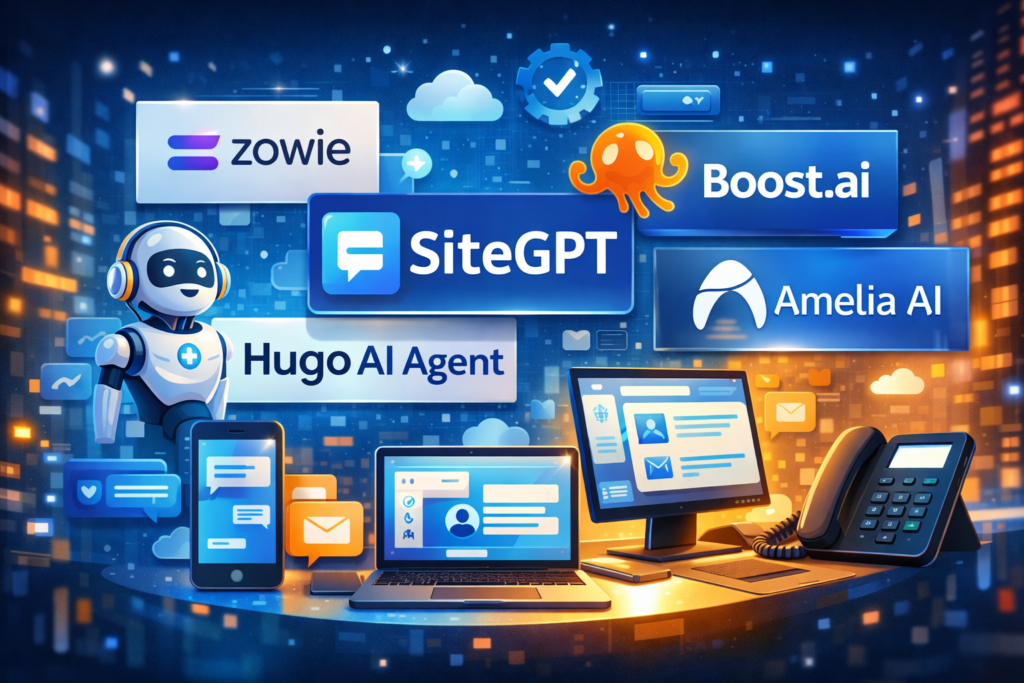
Here are five customer support AI agents worth looking at in 2026.
- Zowie
Try Zowie
Zowie is one of the strongest options in this category if your goal is serious, multi-channel customer support automation. Its platform is built for customer-facing AI agents across chat, email, voice, and social channels, and it emphasizes orchestration, monitoring, coaching, and continuous improvement rather than just basic FAQ replies.
What makes Zowie stand out is that it is not positioned as a simple website bot. It is designed to understand customer intent, apply business logic and rules, connect with systems, and improve over time using monitoring and AI coaching. For businesses that want an AI support layer that feels closer to an operational platform than a lightweight widget, Zowie is one of the most serious options on this list.
Best for: ecommerce brands, larger support teams, and businesses that want AI across multiple support channels.
- Hugo AI Agent
Try Hugo AI Agent
Hugo AI Agent is a customer support AI tool built inside the Crisp ecosystem. It is designed to resolve tickets faster, automate repetitive support work, and serve customers around the clock. Crisp’s own documentation also describes Hugo as understanding customer intent and context, then proactively guiding users toward resolution rather than only answering static questions.
That makes Hugo especially interesting for teams already using Crisp, or for businesses that want a support AI agent closely tied to live chat and support workflows instead of a disconnected chatbot layer. If your priority is faster deployment inside an existing support environment, Hugo has a practical advantage over tools that require more custom implementation.
Best for: Crisp users, SaaS support teams, and companies that want a support agent embedded into an existing support stack.
- SiteGPT
Try SiteGPT
SiteGPT is a strong option for businesses that want to launch an AI support agent quickly without a heavy setup process. The product is positioned as “ChatGPT for your product,” trained on your website content, and built to instantly answer visitor questions. It also highlights personalized onboarding help, support for 95+ languages, and a free trial, which makes it appealing for lean teams and smaller companies.
Its core strength is simplicity. If your goal is to turn your website, docs, and help content into a customer-facing support experience fast, SiteGPT is easier to understand and deploy than enterprise-focused tools. It fits especially well for startups, SaaS products, and small businesses that need an always-on support layer but do not want a long enterprise rollout.
Best for: startups, SaaS companies, and smaller teams that want a website-trained support bot with fast setup.
- Boost.ai
Try Boost.ai
Boost.ai is more enterprise-oriented and focuses on conversational AI for customer self-service across chat and voice. The company positions itself around end-to-end conversational AI, cross-channel deployment, and a hybrid AI approach, with strong emphasis on self-service rates, customer satisfaction, and enterprise readiness.
This makes Boost.ai a good fit for businesses that care about structured automation, compliance, scalability, and large support operations rather than just putting a chatbot on a landing page. The positioning feels particularly relevant for industries like financial services, insurance, telecom, and public sector, where reliability and controlled workflows matter more than flashy demos.
Best for: enterprises, regulated industries, and support teams that want scalable self-service across chat and voice.
- Amelia AI
Try Amelia AI
Amelia AI is a more established conversational AI platform aimed at contact centers and enterprise service operations. SoundHound describes Amelia as helping augment contact centers by offloading high-volume requests to AI agents while also coaching human reps when escalations happen. That means Amelia is not only about deflecting tickets, but also about supporting hybrid AI + human service environments.
Compared with lighter tools, Amelia is better suited for companies with more complex service operations, especially those handling voice, enterprise workflows, and large-scale customer service environments. It looks less like a simple chatbot product and more like part of a broader service automation architecture.
Best for: enterprises, contact centers, and organizations with complex service workflows.
Which Customer Support AI Agent Should You Choose?
The right choice depends on what kind of support operation you actually have.
If you want a more advanced customer service automation platform across channels, Zowie is one of the strongest picks.
If you already use Crisp or want tight integration with a live support environment, Hugo AI Agent is the most natural fit.
If you want something simpler, faster, and easier to deploy from your website content, SiteGPT is the most straightforward option.
If you are running a larger, more structured support organization, Boost.ai and Amelia AI are better choices to evaluate.
Final Thoughts
Customer support is one of the clearest use cases for AI agents because the pain points are obvious: customers want fast answers, businesses need 24/7 coverage, and support teams are under pressure to do more with less. The tools above take different approaches, but all of them are trying to solve the same core problem: scaling support without scaling headcount at the same rate.
If you are exploring the best customer support AI agents in 2026, these five are a solid place to start.
Leave a Reply