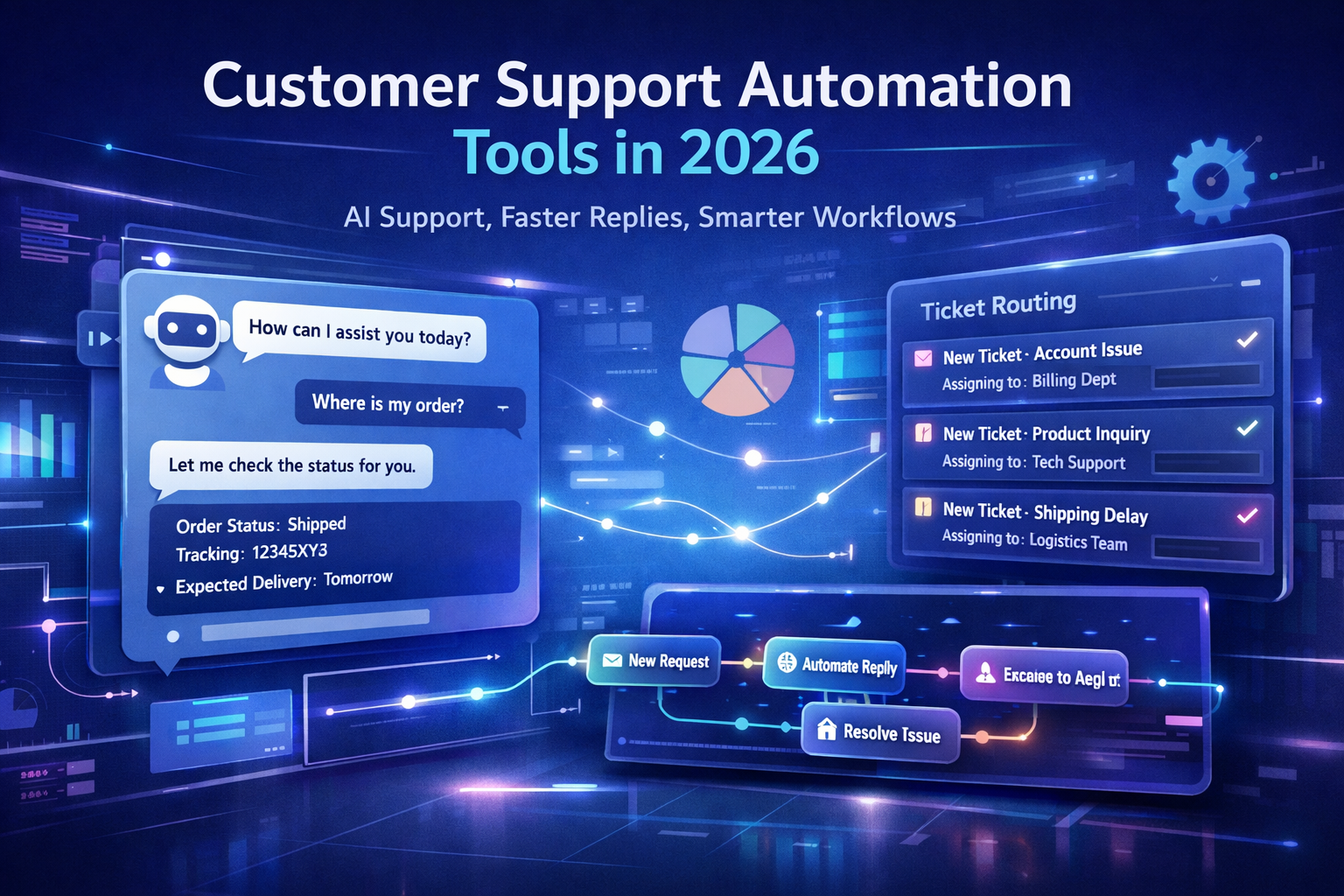
Customer support automation is no longer just about adding a basic chatbot to your website. In 2026, the best customer support automation tools can help businesses answer repetitive questions, route tickets faster, reduce response times, and improve support quality without hiring a large team.
For startups, SaaS teams, ecommerce stores, and service businesses, support automation is one of the easiest ways to save time and scale operations. Instead of making agents manually answer the same questions over and over again, modern support tools can automate FAQ handling, lead qualification, ticket triage, multilingual responses, and even handoff to human agents when needed.
In this guide, we look at some of the most interesting customer support automation tools worth watching in 2026.
Why Customer Support Automation Matters
Support teams usually get stuck doing the same work repeatedly:
answering common questions
routing users to the right department
checking order or account status
collecting customer details before handoff
responding across multiple channels
That is where customer support automation becomes valuable. The right tool can help businesses:
reduce first response time
improve support coverage
handle more tickets with fewer people
offer 24/7 support
maintain more consistent answers
For small businesses, this means less manual workload. For larger teams, it means better efficiency and better customer experience.
Best Customer Support Automation Tools to Watch
- SiteGPT
SiteGPT is a useful option for companies that want to turn website content into an AI-powered support assistant. Instead of building a support bot from scratch, businesses can use their existing website, help center, or documentation as the knowledge source.
This makes SiteGPT especially attractive for companies that already have a decent amount of written support content but want to make it easier for users to get answers quickly.
Best for:
Businesses that want to automate support using existing website content
Why it stands out:
It reduces the setup burden and can make support content instantly more accessible.
- Zowie AI
Zowie AI focuses heavily on ecommerce and customer service automation. It is designed to help brands automate support interactions while still keeping the customer experience smooth.
For online stores, support often revolves around repetitive issues like shipping updates, returns, order changes, and product questions. A tool like Zowie can be valuable because it is built with those use cases in mind rather than acting as a generic AI chatbot.
Best for:
Ecommerce brands that want faster and more automated customer support
Why it stands out:
It is closely aligned with real ecommerce support workflows, not just generic chat automation.
- Amelia AI
Amelia AI is one of the better-known names in the enterprise virtual agent space. It is more than a simple FAQ bot. It is designed for organizations that need advanced conversational automation across customer service and internal service workflows.
This makes Amelia more suitable for larger businesses that need structured automation, more complex workflows, and higher expectations around enterprise-level service delivery.
Best for:
Enterprise teams that need advanced conversational automation
Why it stands out:
It goes beyond basic chat and is aimed at more sophisticated service operations.
- Boost.ai
Boost.ai is another strong player in conversational AI for support automation. It is often associated with enterprises and organizations that need scalable virtual agents capable of handling large volumes of inquiries.
A major benefit of tools like Boost.ai is that they allow businesses to automate a meaningful share of incoming support requests while still preserving paths for human escalation when necessary.
Best for:
Companies with high support volume and a need for scalable automation
Why it stands out:
It is built for serious support operations rather than lightweight website chat only.
- Ultimate.ai
Ultimate.ai is built around automating customer support at scale, especially for teams dealing with large ticket volumes and multilingual support demands. This can be particularly useful for global businesses that serve customers across different markets.
Instead of just automating one channel, tools in this category are often used to improve the whole support pipeline, from handling incoming queries to routing and assisting agents.
Best for:
Support teams handling multilingual or high-volume customer service
Why it stands out:
It is focused on reducing support load while improving speed and consistency.
How to Choose the Right Customer Support Automation Tool
Not every support automation platform is built for the same purpose. Before choosing one, it helps to ask a few practical questions:
- What kind of support requests do you get most often?
If your team mostly answers repetitive questions, a website-trained AI assistant may be enough. If you deal with tickets, routing, or order issues, you may need something more workflow-oriented.
- Do you need ecommerce support or general business support?
Some tools are better for ecommerce brands, while others are designed for SaaS, enterprise service desks, or large customer operations.
- How important is multilingual support?
If your audience is global, multilingual automation can save a lot of time and improve customer satisfaction.
- Do you want full automation or human handoff?
The best customer support automation setups usually combine both. AI handles repetitive work, while humans step in for complex or sensitive cases.
Final Thoughts
Customer support automation is becoming one of the clearest use cases for AI in business. It saves time, improves response speed, and helps teams scale without letting support quality collapse.
For smaller companies, it can remove a lot of repetitive manual work. For larger organizations, it can become part of a much bigger service efficiency strategy.
If you are exploring customer support automation in 2026, tools like SiteGPT, Zowie AI, Amelia AI, Boost.ai, and Ultimate.ai are worth watching because they reflect different approaches to the same goal: delivering faster, more scalable, and more efficient customer support.
Leave a Reply