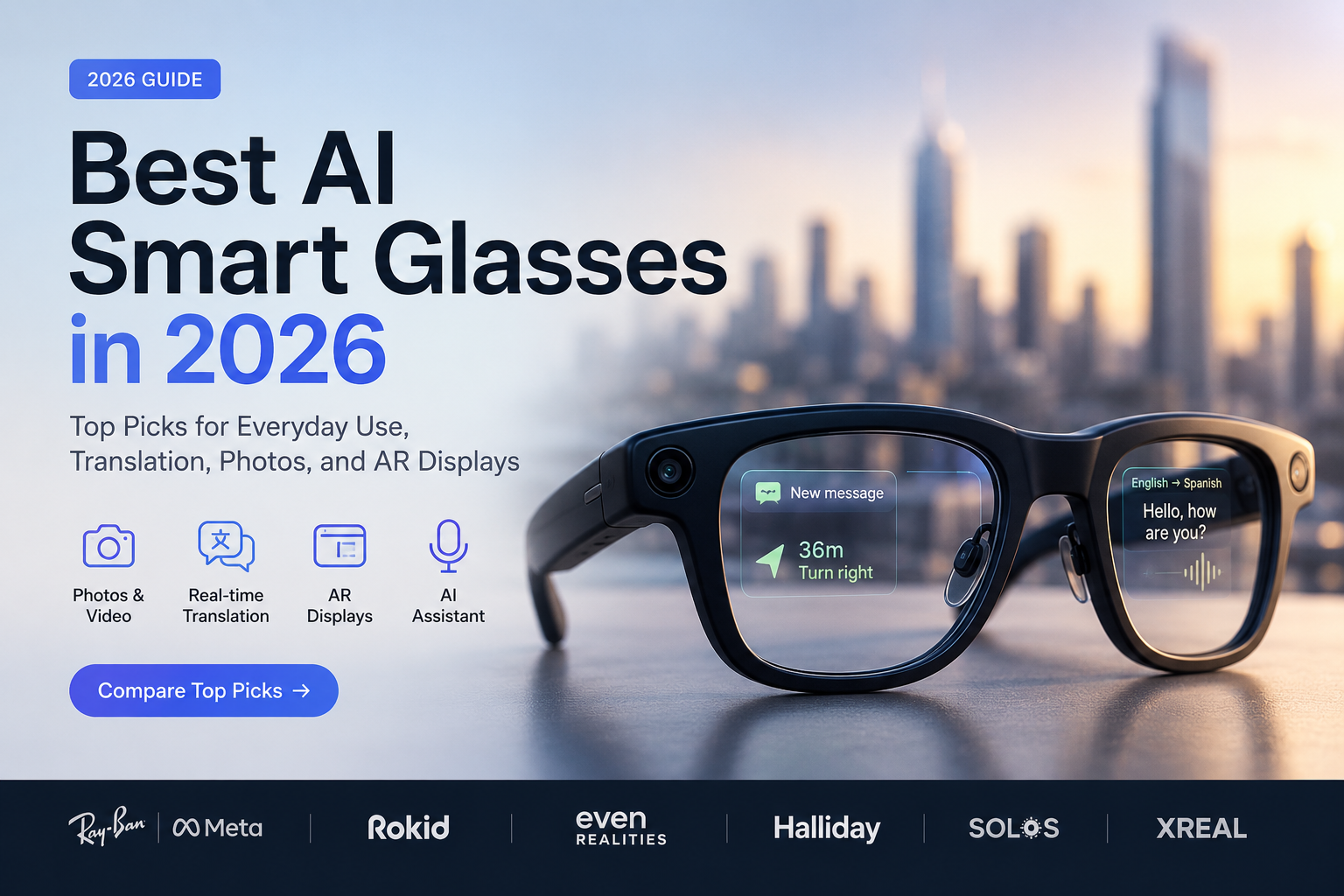
AI smart glasses are moving from futuristic gadgets to practical everyday devices. In 2026, the market is no longer just about taking hands-free photos. The best AI smart glasses can now help with real-time translation, voice assistants, video capture, live captions, navigation, note-taking, and even lightweight AR displays.
But there is one important thing to understand first: not all AI smart glasses are the same.
Some are camera-first glasses, like Ray-Ban Meta and Solos AirGo. Some are display-first glasses, like Even Realities G1 and Halliday. Some are closer to AR or spatial computing devices, like Rokid and Xreal. And some upcoming models from Google, Samsung, Warby Parker, Gentle Monster, and Xreal may push the category further in late 2026.
This guide compares the best AI smart glasses in 2026 based on real buying intent: comfort, AI features, camera quality, display usefulness, translation, daily wearability, and price.
Quick Answer: What Are the Best AI Smart Glasses in 2026?
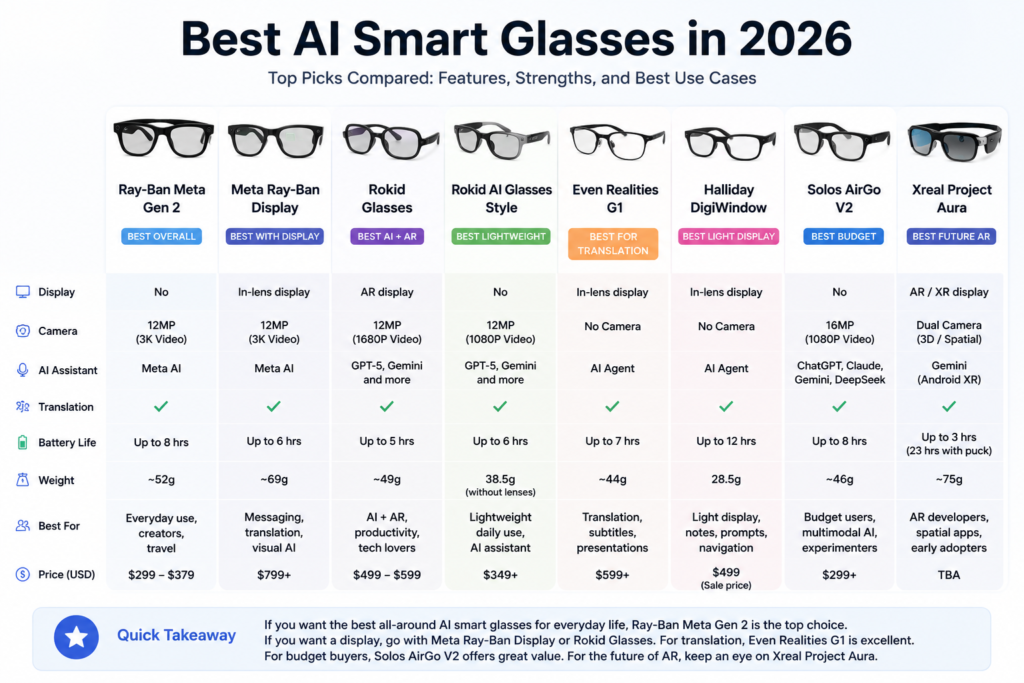
The best AI smart glasses for most people in 2026 are Ray-Ban Meta Gen 2 because they combine familiar eyewear design, hands-free camera capture, audio, voice control, and Meta AI in a polished consumer product. The latest generation adds upgraded video and longer battery life compared with earlier models.
For users who want a visual display, Meta Ray-Ban Display, Even Realities G1, Halliday DigiWindow, and Rokid Glasses are more interesting. Meta Ray-Ban Display adds an in-lens display for messages, translations, AI responses, and photo previews. Even Realities G1 focuses more on discreet information display, subtitles, and translation. Rokid is stronger for users who want AI plus AR-style display functions.
Best AI Smart Glasses in 2026: Comparison Table
Product Best For Display Camera Key Strength Main Limitation
Ray-Ban Meta Gen 2 Most everyday users No Yes Best mainstream AI glasses No visual display
Meta Ray-Ban Display Best Meta glasses with display Yes Yes Visual AI responses and messages Higher price
Rokid Glasses AI + AR display users Yes Yes Lightweight AR-style AI glasses Less mainstream than Meta
Rokid AI Glasses Style Lightweight AI camera glasses No major AR display focus Yes Light frame and AI assistant Newer ecosystem
Even Realities G1 Translation and subtitles Yes No Discreet display without camera Expensive for limited functions
Halliday DigiWindow Lightweight display glasses Yes Not camera-first Very light, invisible display concept Still a newer brand
Solos AirGo V2 Budget AI camera glasses No Yes Multimodal AI at lower price Less fashion appeal than Ray-Ban
Xreal Project Aura Future AR/spatial computing Yes Yes Android XR and spatial apps Not a normal everyday glasses product yet
- Ray-Ban Meta Gen 2 — Best AI Smart Glasses for Most People
Ray-Ban Meta Gen 2 is the safest recommendation for most buyers in 2026. It looks like normal eyewear, comes from a known brand, and focuses on practical daily functions: hands-free photos, video capture, music, calls, voice commands, and Meta AI.
The newest generation includes upgraded camera and video features, including 3K Ultra HD video according to Meta’s product page, and improved battery life compared with the previous generation. Ray-Ban’s official page also describes additional battery capacity and low-power AI features for the latest generation.
Why it stands out
Ray-Ban Meta works because it does not ask users to change their behavior too much. You wear glasses, ask questions, take photos, listen to audio, and make calls. That is much easier to understand than a full AR headset.
Best for
Ray-Ban Meta Gen 2 is best for:
Everyday users
Creators
Travelers
People who want hands-free photo and video capture
Buyers who care about style and brand trust
Who should skip it
Skip Ray-Ban Meta if you need a built-in display. Standard Ray-Ban Meta glasses are excellent camera-and-audio AI glasses, but they are not display glasses.
- Meta Ray-Ban Display — Best AI Smart Glasses with a Built-in Display
Meta Ray-Ban Display is one of the most important products in the AI glasses category because it adds a small in-lens display to the Ray-Ban Meta concept.
According to Meta, the display can show messages, photo previews, translations, Meta AI responses, and other glanceable information without requiring the user to pull out a phone.
This matters because it moves smart glasses from “voice assistant on your face” toward a real visual computing device.
Why it stands out
The biggest advantage is the combination of:
Familiar Ray-Ban design
Camera
AI assistant
In-lens display
Messaging and translation support
Strong Meta ecosystem
This makes it more useful than audio-only AI glasses for people who want quick visual information.
Best for
Meta Ray-Ban Display is best for:
Users who want visual AI responses
People who use messaging often
Travelers who want translation support
Early adopters who want the next step beyond standard Ray-Ban Meta
Who should skip it
Skip it if you only need simple camera glasses. The display makes it more advanced, but also more expensive and more specialized.
- Rokid Glasses — Best AI Smart Glasses for AR Display Features
Rokid is one of the most interesting AI glasses brands in 2026 because it focuses more heavily on AI plus AR functionality.
Rokid’s global product page highlights features such as a 12MP Sony IMX681 camera, 1680P video, 12MP photo capture, and built-in support for AI assistants including GPT-5 and Gemini. Rokid has also positioned its glasses as lightweight AI and AR smart glasses, with mass-production units reportedly shipping worldwide by late 2025.
Why it stands out
Rokid is not just trying to make audio glasses. It is trying to combine:
AI assistant access
Camera capture
Translation
Display functions
AR-style use cases
That makes it more attractive for users who want smart glasses to become a real productivity or information device.
Best for
Rokid Glasses are best for:
AR enthusiasts
Tech-heavy users
Translation use cases
People who want both camera and display functions
Early adopters who want more than Ray-Ban Meta
Who should skip it
Skip Rokid if you want the most mainstream consumer ecosystem. Meta still has stronger consumer awareness and retail presence.
- Rokid AI Glasses Style — Best Lightweight AI Camera Glasses
Rokid AI Glasses Style is a lighter, more everyday-oriented option from Rokid. The product page lists a 38.5g frame weight excluding lenses, built-in AI assistant support, a 12MP POV camera, prescription lens service, and a starting price of $349 excluding tax.
This product is interesting because it competes more directly with Ray-Ban Meta-style use cases: daily wear, camera, audio, and AI assistance.
Why it stands out
The biggest selling point is weight. Smart glasses fail when people do not want to wear them all day. A lighter frame gives Rokid a better chance of becoming a daily device instead of a gadget that stays on the desk.
Best for
Rokid AI Glasses Style is best for:
Users who want lightweight AI glasses
People who want a camera and assistant
Buyers who care about prescription lens support
Users who want an alternative to Ray-Ban Meta
Who should skip it
Skip it if you need a mature app ecosystem or strong brand recognition. Rokid is promising, but it is still not as mainstream as Meta.
- Even Realities G1 — Best AI Smart Glasses for Translation and Subtitles
Even Realities G1 takes a different approach. It is not camera-first. Instead, it focuses on a discreet visual display, real-time translation, transcription, navigation-style information, and teleprompter-like use cases.
Even Realities highlights real-time translations and transcriptions appearing in the user’s field of vision. Engadget reported that the G1 costs $599, with corrective lenses and sunglass clips adding extra cost.
Why it stands out
Even Realities G1 is attractive because it avoids one of the biggest privacy problems with camera glasses: it does not rely on a camera as the central feature.
That makes it better for users who want information display without constantly pointing a camera at the world.
Best for
Even Realities G1 is best for:
Real-time translation
Subtitles and transcription
Presentations
Reading prompts
Users who do not want camera glasses
Who should skip it
Skip it if you mainly want photos, videos, or visual AI recognition. Without a camera-first design, it is less useful for creator-style use cases.
- Halliday DigiWindow — Best Lightweight Display AI Glasses to Watch
Halliday is another display-focused AI glasses option. The company describes its glasses as lightweight, with a 28.5g design and up to 12 hours of battery life. Its product page lists Halliday DigiWindow Glasses at $499 regular price, with sale pricing shown at the time of access.
Halliday also ran a Kickstarter campaign for proactive AI glasses with an invisible display, raising more than $3 million from over 8,000 backers.
Why it stands out
Halliday is interesting because it focuses on making the display feel less intrusive. The core idea is not to replace your phone screen, but to give you just enough information at the right time.
Best for
Halliday is best for:
Lightweight display glasses
Early adopters
Users who want glanceable AI information
People interested in invisible display concepts
Who should skip it
Skip Halliday if you want the safest mainstream purchase. It is promising, but buyers should check current shipping status, reviews, and return policy before purchasing.
- Solos AirGo V2 — Best Budget AI Smart Glasses with Camera
Solos AirGo V2 is one of the most value-focused AI smart glasses options in 2026. It launched at CES 2026 with a 16MP camera, multimodal AI features, and support for AI models such as ChatGPT, Claude, Gemini, and DeepSeek. Reports place the price around $299.
Solos’ earlier AirGo Vision line also supported ChatGPT-style AI functions and a swappable frame system.
Why it stands out
Solos competes on function and price. It may not have the fashion strength of Ray-Ban, but it offers serious AI features for a lower price.
Best for
Solos AirGo V2 is best for:
Budget-conscious buyers
Users who want multimodal AI
People who want camera-based AI recognition
Developers and experimenters
Who should skip it
Skip Solos if style, brand familiarity, and retail support matter more than specs.
- Xreal Project Aura — Best Future AR Glasses to Watch in 2026
Xreal Project Aura is not the same type of product as Ray-Ban Meta. It is closer to lightweight XR or spatial computing glasses.
At Google I/O 2026, Xreal Project Aura was shown as an Android XR device with a compute puck, dual displays, cameras, speakers, spatial tracking, and a 70-degree field of view. The Verge also reported that Google is working with partners including Samsung, Xreal, Gentle Monster, and Warby Parker on Android XR smart glasses and related devices.
Why it stands out
Xreal Project Aura matters because it points toward the next stage of smart glasses: not just camera glasses, but wearable spatial computing.
Best for
Xreal Project Aura is best for:
AR developers
Spatial computing users
Early adopters
People who want virtual monitors and Android XR apps
Who should skip it
Skip it if you want normal glasses for daily wear. This is more of a future-facing XR product than simple everyday eyewear.
How to Choose the Best AI Smart Glasses
- Choose Camera Glasses If You Want Photos and Videos
If your main use case is recording your day, capturing travel moments, taking quick POV videos, or asking AI about what you see, choose camera-first glasses.
Best options:
Ray-Ban Meta Gen 2
Solos AirGo V2
Rokid AI Glasses Style
- Choose Display Glasses If You Want Translation and Subtitles
If you want information inside your field of vision, display glasses are more useful than camera-only glasses.
Best options:
Meta Ray-Ban Display
Even Realities G1
Halliday DigiWindow
Rokid Glasses
- Choose AR Glasses If You Want Spatial Computing
If you want virtual screens, Android XR apps, or immersive display experiences, you need AR or XR-style glasses.
Best options:
Rokid Glasses
Xreal Project Aura
Future Android XR glasses from Google and Samsung partners
- Choose Based on Comfort First
Comfort is more important than specs. If the glasses are too heavy, too warm, too awkward, or too strange-looking, you will stop wearing them.
For everyday use, frame weight, lens options, nose fit, battery life, and charging case design matter as much as AI features.
Final Verdict: What Are the Best AI Smart Glasses in 2026?
For most people, Ray-Ban Meta Gen 2 is the best AI smart glasses choice in 2026. It offers the strongest combination of design, camera, audio, AI assistant features, and mainstream usability.
For users who want a built-in display, Meta Ray-Ban Display is the most important premium option to consider. It brings AI responses, translation, messages, and photo previews into the lens.
For translation and discreet subtitles, Even Realities G1 is one of the best choices. For AR-style AI glasses, Rokid Glasses and Xreal Project Aura are more future-facing options. For buyers who want lower-cost multimodal AI glasses, Solos AirGo V2 is worth watching closely.
The key decision is simple:
Choose Ray-Ban Meta for everyday AI camera glasses. Choose Even Realities or Halliday for discreet display. Choose Rokid or Xreal if you want the future of AR glasses. Choose Solos if you want AI features at a lower price.
FAQ
Are AI smart glasses worth it in 2026?
Yes, AI smart glasses are worth it if you have a clear use case such as hands-free photos, video capture, real-time translation, subtitles, voice assistance, or AR display. They are less worth it if you only want a novelty gadget.
What are the best AI smart glasses for everyday use?
Ray-Ban Meta Gen 2 is the best everyday choice for most people because it looks like normal eyewear and combines camera, audio, calls, and AI assistant features in a polished product.
What are the best AI smart glasses with a display?
Meta Ray-Ban Display, Even Realities G1, Halliday DigiWindow, and Rokid Glasses are among the most interesting display-based AI smart glasses in 2026.
What are the best AI smart glasses for translation?
Even Realities G1, Meta Ray-Ban Display, Rokid Glasses, and Halliday are strong options for translation-related use cases, depending on whether you prefer subtitles, voice AI, or AR-style display features.
Do AI smart glasses have cameras?
Some AI smart glasses have cameras, including Ray-Ban Meta, Rokid, and Solos AirGo. Others, such as Even Realities G1, focus more on display and translation rather than camera capture.
Are AI smart glasses private?
Privacy depends on the product and how it is used. Camera glasses can raise privacy concerns because they may record photos, videos, or audio in public spaces. Buyers should check recording indicators, local laws, and platform privacy policies before using camera-based smart glasses.
Related Video: AI Smart Glasses and AR Wearables in 2026👇