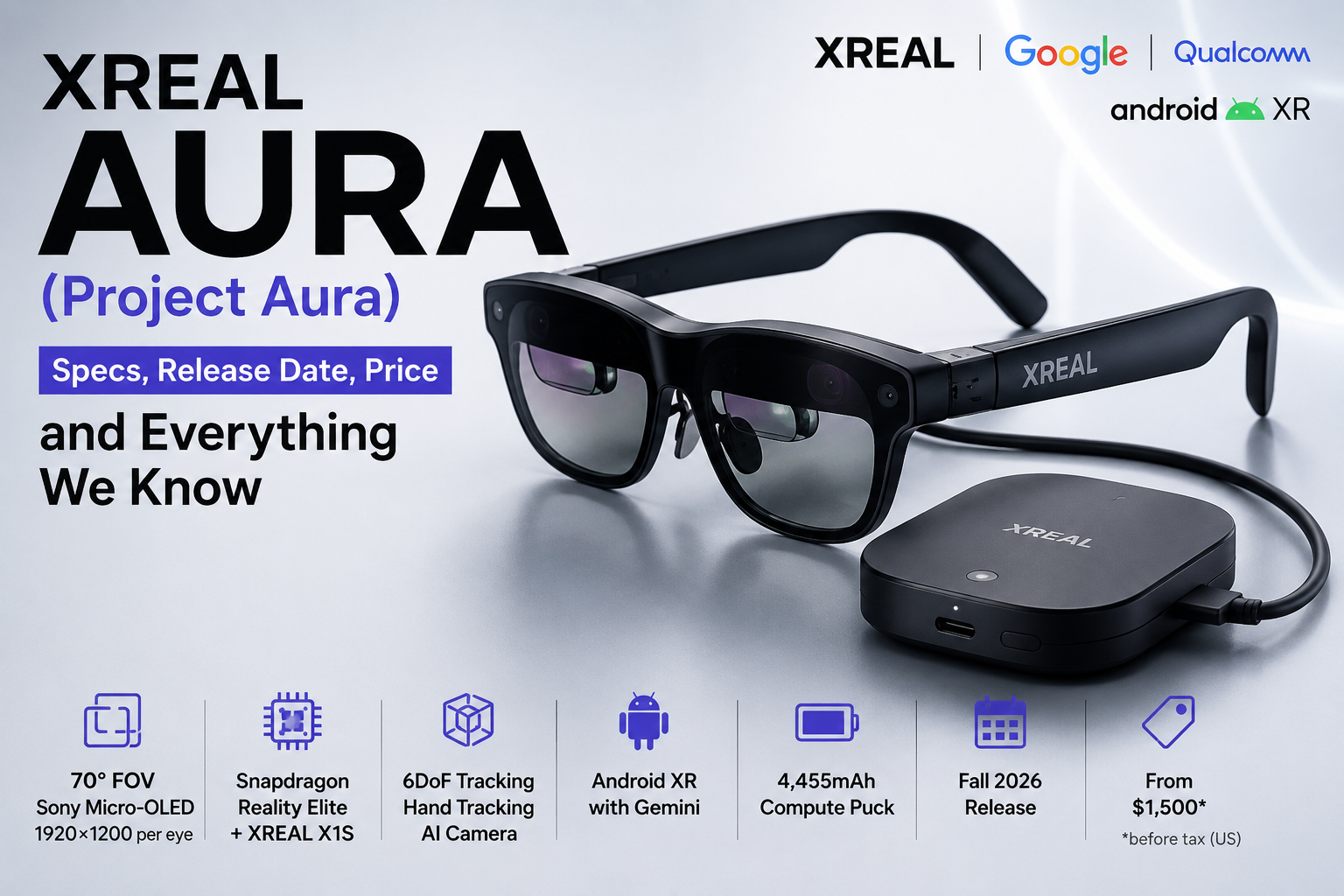
XREAL Project Aura now has an official product name: XREAL AURA.
Developed in collaboration with Google and Qualcomm, XREAL AURA is a pair of wired optical-see-through XR glasses powered by Android XR and Gemini. Unlike conventional smart glasses that mainly provide a camera, speakers or a simple heads-up display, AURA is designed as a portable spatial computer with full 6DoF tracking, hand tracking, Android applications and a dedicated compute puck.
XREAL has now published most of the core hardware specifications. The company plans to release AURA in Fall 2026, while the base model is expected to cost no more than $1,500 before tax in the United States. Exact configurations, final pricing and regional shipping dates have not yet been announced.
Quick Answer
XREAL AURA, previously known as Project Aura, is an Android XR spatial computing device consisting of lightweight glasses connected to a dedicated compute puck.
Its confirmed highlights include:
A 70-degree optical-see-through field of view
Sony Micro-OLED displays with 1920 × 1200 pixels per eye
Refresh rates of up to 120Hz
Android XR with Gemini
Snapdragon Reality Elite in the compute puck
XREAL X1S Spatial Coprocessor in the glasses
6DoF spatial tracking and hand tracking
A high-resolution AI camera with a privacy indicator
12GB/256GB and 16GB/512GB configurations
A planned Fall 2026 launch
A base-model price no higher than $1,500 before tax
However, important details such as the final price, total weight, practical battery life and exact shipping date remain unconfirmed.
XREAL AURA Specs at a Glance
Specification Confirmed details
Official product name XREAL AURA
Former project name XREAL Project Aura
Product type Wired optical-see-through XR glasses
Operating system Android XR
AI assistant Gemini on Android XR
Glasses processor XREAL X1S Spatial Coprocessor
Compute processor Snapdragon Reality Elite
Display type Sony Micro-OLED
Resolution 1920 × 1200 pixels per eye
Field of view 70 degrees
Refresh rate Up to 120Hz
Spatial tracking 6DoF spatial anchoring
Hand tracking Supported
Tracking cameras Two world-facing tracking cameras
Main camera High-resolution camera with privacy LED
Dimming Five-level electrochromic dimming
Audio Bose EQ tuning and Android XR spatial audio
Microphones Four-microphone array
Memory and storage 12GB/256GB or 16GB/512GB
Battery 4,455mAh, 34.84Wh
Wireless connectivity Wi-Fi 6/6E and Bluetooth 5.3
External display input DisplayPort Alt Mode through USB-C
Prescription support Insertable prescription lenses
Planned release Fall 2026
Expected US price Base model no more than $1,500 before tax
Weight Not yet announced
Rated battery life Not yet announced
These specifications are based on XREAL’s current official product page and may still be revised before commercial release.
What Is XREAL Project Aura?
Project Aura was the development name for XREAL’s first Android XR spatial computing glasses. The product was initially previewed as Project Aura before receiving its commercial name, XREAL AURA, in 2026.
Google describes AURA as its first wired XR glasses category device powered by Android XR. Rather than putting all processing hardware inside the glasses, XREAL uses a split-compute design:
The glasses contain the displays, sensors and X1S spatial coprocessor.
A wired compute puck contains the Snapdragon Reality Elite platform, battery, memory, storage and physical controls.
This approach moves much of the heat, battery weight and high-performance processing away from the user’s face. It also allows AURA to deliver more advanced spatial computing than lightweight audio-and-camera smart glasses, without requiring the bulk of a conventional XR headset.
XREAL positions AURA as neither a traditional headset nor a basic pair of display glasses. Its intended uses include private-screen entertainment, spatial workspaces, Android applications, immersive maps, three-dimensional creation and AI assistance.
Watch XREAL AURA in Action
The following hands-on video provides a closer look at the XREAL AURA glasses, connected compute puck, and early Android XR experience. Since AURA is still a pre-release product, the final hardware, software, features, and user experience may change before launch.
Video embedded from YouTube for reference. The video and opinions belong to the original creator. This article is independently produced and is not affiliated with the video creator or XREAL.
XREAL AURA Release Date
XREAL says that AURA is expected to launch in Fall 2026.
The company has not yet announced an exact release day. Regional shipping may also begin at different times, depending on the official launch schedule in each market.
XREAL currently lists the United States, United Kingdom, Japan, South Korea and numerous European countries among its supported launch regions. Buyers outside those regions can register for availability notifications.
Reservations are already open, but XREAL explicitly states that the current reservation program is not a preorder. Final pricing, configurations and shipping information will be disclosed closer to launch, and customers will still need to confirm their final purchase.
Expected release timeline
Milestone Status
Initial Project Aura preview Completed
Public demonstrations and developer access Underway
Reservations Open
Final price announcement Not yet announced
Commercial launch Expected Fall 2026
Exact shipping date Not yet announced
XREAL AURA Price
XREAL says the final retail price of the AURA base model will be no more than $1,500 before tax in the United States.
That is currently a price ceiling rather than a confirmed selling price. XREAL may offer multiple configurations because its official specifications list both:
12GB RAM with 256GB storage
16GB RAM with 512GB storage
The company has not confirmed whether the $1,500 limit applies only to the lower-capacity configuration or how much the higher-capacity version will cost.
In Japan, XREAL says the base model is expected to cost no more than ¥240,000 including tax. Final regional prices and bundles will be announced closer to release.
At this price level, AURA will compete more directly with premium spatial computing devices than with mainstream camera-first smart glasses. Its value will therefore depend heavily on comfort, software quality, battery life and whether Android XR develops a strong application ecosystem.
Display and Optics
The display is one of AURA’s most important features.
XREAL AURA uses:
Sony Micro-OLED display panels
1920 × 1200 pixels per eye
Up to 120Hz refresh rate
X Prism optical technology
A 70-degree field of view
Optical-see-through viewing
Five levels of electrochromic dimming
The 70-degree field of view is considerably larger than the narrow information displays found in many lightweight smart glasses. It is intended to provide enough visual space for multiple windows, immersive media and spatial Android applications.
Because AURA uses optical-see-through technology, users see the real world directly through the lenses. Digital images are layered over that view rather than displaying the physical environment through video passthrough cameras.
This avoids camera-passthrough latency and allows other people to see the wearer’s eyes. However, practical image visibility will still depend on ambient light, display brightness, lens adjustment and how well the optics fit each user. XREAL has not yet published final brightness figures.
Electrochromic dimming
AURA includes automatic and manual electrochromic dimming with five transparency levels.
This should allow users to choose between greater awareness of their surroundings and a darker background for entertainment or focused work. It may also improve perceived contrast in brighter environments, although real-world performance will need to be tested after release.
Dual-Chip Split-Compute Architecture
XREAL AURA uses two main processors.
The glasses contain the XREAL X1S Spatial Coprocessor, which handles low-latency spatial display functions, sensor processing and stable XR presentation.
The compute puck contains Qualcomm’s Snapdragon Reality Elite platform, which runs Android XR, Gemini and more demanding spatial workloads.
Qualcomm says Snapdragon Reality Elite is designed for optical-see-through and mixed-reality devices, with improved on-device AI, tracking, graphics performance and power efficiency. Qualcomm lists up to 48 TOPS of AI processing for the platform, although actual AURA performance will depend on XREAL’s hardware configuration, cooling and software implementation.
Separating these functions may provide several advantages:
Less heat concentrated in the glasses
More room for a larger battery
Higher sustained computing performance
Lighter eyewear than a fully self-contained headset
Easier access to storage, ports and physical controls
The trade-off is that users must carry the compute puck and keep it connected to the glasses by cable.
Android XR and Gemini
AURA runs Android XR, Google’s platform for XR headsets and glasses.
XREAL says users will have access to familiar applications through Google Play, including services such as YouTube, Chrome, Google Maps, Google Photos and Gemini. The company also says that more than 100 applications designed specifically for XR are expected to be available through the ecosystem.
Gemini is integrated as the device’s AI assistant. With user permission, it can use voice, screen context and visual information from the camera to help users:
Open and navigate applications
Understand objects or information in front of them
Get contextual assistance
Search for information
Work with spatial content
Support learning and creative tasks
The long-term value of AURA will depend partly on how well standard Android applications adapt to spatial interfaces and how quickly developers create applications specifically for Android XR.
Cameras, Tracking and AI Perception
XREAL AURA includes two world-facing tracking cameras for spatial positioning.
Confirmed tracking and perception features include:
6DoF spatial anchoring
Hand tracking
Two world-facing tracking cameras
A separate high-resolution camera
Real-time AI perception
A visible privacy LED for the main camera
Six-degree-of-freedom tracking allows virtual screens and objects to remain anchored within the user’s physical environment as the wearer moves their head and body.
Hand tracking provides a more natural way to interact with Android XR content without always using a separate controller. The compute puck also includes a touchpad, while keyboards, mice and gaming controllers can connect through Bluetooth.
The high-resolution camera is intended to support Gemini and other AI vision functions. XREAL says it includes a privacy LED so people nearby can see when the camera is active. Practical privacy controls, recording behavior and application permissions will require closer examination when the final software is released.
Audio and Voice Input
AURA has a four-microphone array and integrated audio with Bose EQ tuning.
Android XR also provides spatial audio processing. The combination is designed to support:
Gemini voice conversations
Calls and meetings
Entertainment
Directional spatial audio
Voice control
Environmental and contextual AI input
XREAL has not yet published detailed speaker specifications, maximum volume figures or information about how much sound may be audible to people nearby.
Compute Puck, Battery and Ports
The compute puck is the main processing and power unit for XREAL AURA.
Confirmed configurations include:
12GB RAM and 256GB storage
16GB RAM and 512GB storage
4,455mAh battery
34.84Wh battery capacity
Wi-Fi 6/6E
Bluetooth 5.3
Fingerprint button
Integrated touchpad
Two USB-C connections
One USB-C port connects the compute puck to the AURA glasses. The second supports charging and DisplayPort input.
Charging specifications include:
Up to 65W input
USB Power Delivery 3.0
PPS support
Qualcomm Quick Charge 3.0
DisplayPort Alt Mode allows AURA to connect to compatible PCs, laptops and handheld gaming devices. This may make it useful as a private spatial monitor in addition to its native Android XR functions.
How long will the battery last?
XREAL has confirmed the battery capacity but has not published an official battery-life rating.
Battery duration will likely vary significantly depending on:
Display brightness
Refresh rate
Gemini and AI usage
Spatial tracking
Wireless connectivity
Application workload
Whether an external device is connected
Until independent testing is available, the 4,455mAh figure alone is not enough to estimate practical all-day performance.
Prescription Lenses and IPD Sizes
XREAL AURA supports insertable prescription lenses for users who need vision correction.
The glasses will also be offered in two interpupillary-distance ranges:
Medium: 60–66mm
Large: 66–72mm
Choosing the correct IPD range will be important for image clarity, visual comfort and alignment. XREAL has not yet announced the price of prescription inserts or whether they will be included with any launch bundle.
What Has Not Been Announced Yet?
Although XREAL has released an unusually detailed specification sheet before launch, several purchasing details remain unknown:
Exact retail price
Price of the 16GB/512GB version
Glasses weight
Compute-puck weight
Cable length and replaceability
Rated battery life
Display brightness
Full dimensions
Prescription-lens pricing
Warranty terms for each region
Final launch-day application list
Exact shipping date
These missing details are important. AURA may have strong display and computing specifications, but comfort, heat, battery life and optical fit will determine whether it works as an everyday device.
Is XREAL AURA Worth Waiting For?
XREAL AURA may be worth waiting for if you want:
A larger optical-see-through display
Full Android XR applications
6DoF spatial computing
Gemini integrated into your visual environment
A portable private workspace
DisplayPort input from a laptop or gaming device
More immersive experiences than basic smart glasses can provide
It may not be the right choice if you want:
Lightweight glasses with no cable or compute puck
A lower-cost consumer device
A simple camera and audio assistant
A product available immediately
Confirmed all-day battery life
A discreet design similar to ordinary eyeglasses
AURA sits between lightweight smart glasses and full XR headsets. It promises more capability than camera-first AI glasses, but its wired compute puck and premium expected price make it a different product category.
For a broader comparison of camera glasses, display glasses and upcoming XR devices, see our guide to the👉 best AI smart glasses in 2026.
Frequently Asked Questions
Is XREAL Project Aura the same as XREAL AURA?
Yes. Project Aura was the development name. XREAL AURA is the official commercial product name.
When will XREAL AURA be released?
XREAL plans to launch AURA in Fall 2026. The company has not announced an exact release or shipping date.
How much will XREAL AURA cost?
XREAL says the base model will cost no more than $1,500 before tax in the United States. Final prices and configurations have not yet been announced.
Is the current reservation a preorder?
No. XREAL describes it as an early reservation rather than a preorder. Customers will still need to confirm the final purchase after pricing and shipping information are announced.
Does XREAL AURA run Android XR?
Yes. AURA runs Android XR and includes Gemini as its integrated AI assistant.
Does XREAL AURA have a display?
Yes. It has Sony Micro-OLED displays with 1920 × 1200 pixels per eye, a 70-degree field of view and refresh rates of up to 120Hz.
Does XREAL AURA support 6DoF tracking?
Yes. It supports 6DoF spatial anchoring and hand tracking through its world-facing sensor system.
Does XREAL AURA have a camera?
Yes. It has two world-facing tracking cameras and a separate high-resolution camera with a privacy indicator for AI perception features.
Can XREAL AURA connect to a computer?
Yes. The compute puck supports DisplayPort Alt Mode input through USB-C for compatible PCs, laptops and handheld gaming devices.
Does XREAL AURA support prescription lenses?
Yes. It supports insertable prescription lenses.
What is the battery life?
XREAL has confirmed a 4,455mAh, 34.84Wh battery but has not announced an official battery-life estimate.
Is XREAL AURA wireless?
The compute puck supports Wi-Fi 6/6E and Bluetooth 5.3, but the glasses themselves connect to the compute puck with a cable.
Final Thoughts
XREAL AURA is one of the most ambitious smart-glasses products scheduled for 2026.
Its 70-degree optical-see-through display, Android XR platform, Gemini integration, hand tracking and split-compute architecture place it closer to a wearable spatial computer than a conventional pair of AI glasses.
The published specifications are promising, but several decisive details remain unknown. Final pricing, weight, battery life, comfort and software quality will determine whether AURA becomes a practical everyday computer or remains a premium device for XR enthusiasts and developers.
For now, the clearest conclusion is that XREAL AURA is not designed to replace simple camera-first smart glasses. It is attempting to bring much of the functionality of a spatial computing headset into a lighter glasses-style form factor.
We will update this page when XREAL confirms the final price, release date, weight, battery-life rating and retail configurations.