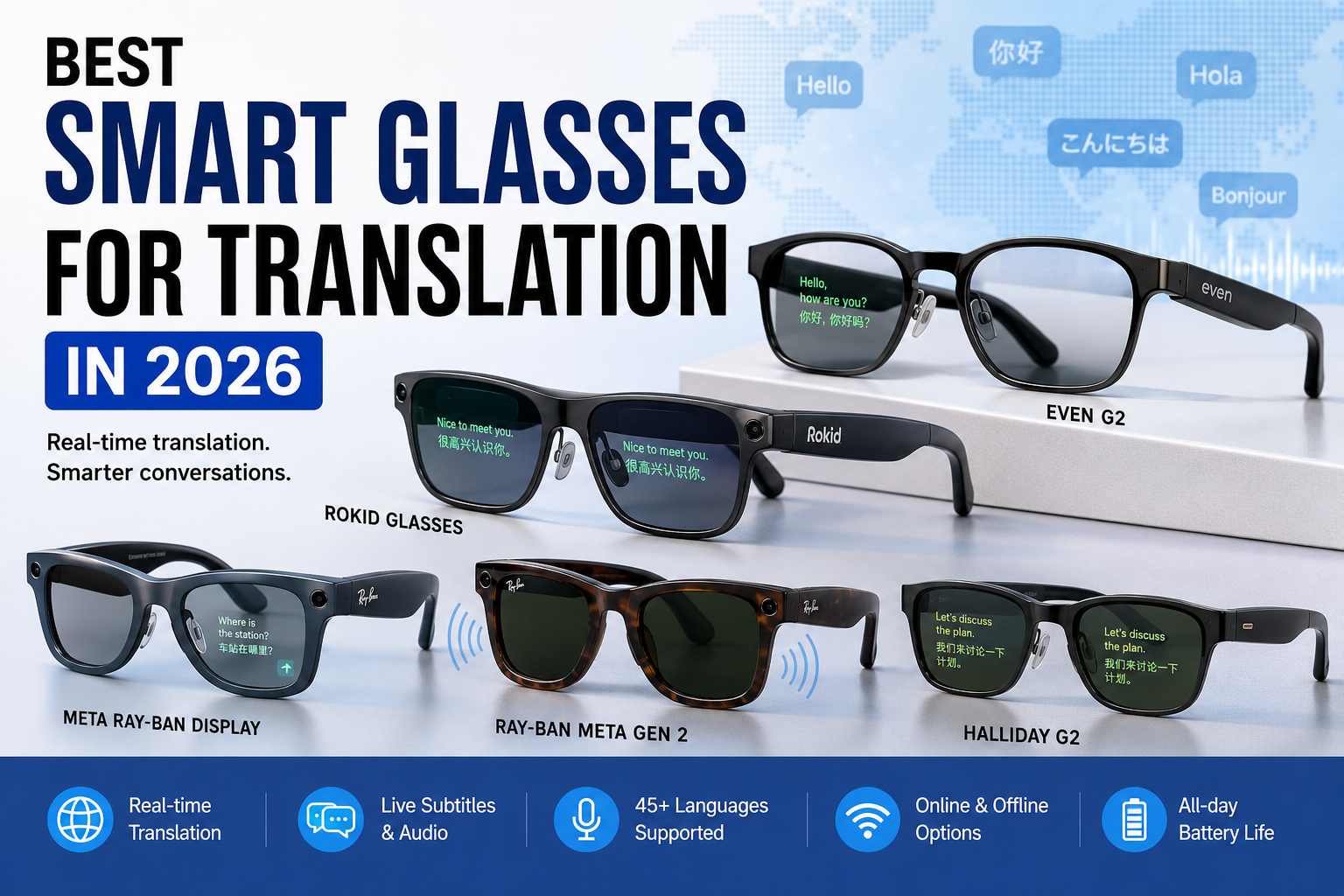
The best smart glasses for translation in 2026 do more than repeat translated speech through a speaker. The most useful models can place live subtitles directly in your field of view, helping you follow conversations without repeatedly looking down at a phone.
However, not all translation glasses work in the same way.
Some models display translated text privately on the lenses. Others use open-ear speakers and provide audio translations without any visual display. Language coverage, internet requirements, battery life, prescription support and privacy also vary significantly between products.
Based on currently published features and availability, Even G2 is our best overall choice for translation-focused users. Its discreet binocular display, camera-free design, support for more than 30 languages and up to two days of battery life make it particularly suitable for travel, meetings and daily conversations.
Rokid Glasses are the stronger option for users who want wider language coverage, a brighter display and additional camera and AI functions. Ray-Ban Meta Gen 2 remains a more natural-looking audio-first alternative, but it does not show translated captions on the lenses.
This guide is based on manufacturer-published specifications and current product information. It does not claim that every model was personally tested under identical conditions.
Quick Answer
The best smart glasses for translation in 2026 are:
Even G2 — Best overall
Rokid Glasses — Best for the widest language coverage
Meta Ray-Ban Display — Best premium Meta option with visual captions
Ray-Ban Meta Gen 2 — Best everyday audio-translation glasses
Halliday G2 — Best upcoming option for multilingual meetings
Best Translation Smart Glasses Compared
Product Best for Translation output Language support Display Starting price
Even G2 Best overall Private text in lenses 35+ marketed Binocular green Micro-LED $599
Rokid Glasses Widest language coverage Live subtitles in lenses Up to 89 languages Dual-eye Micro-LED $699
Meta Ray-Ban Display Premium Meta ecosystem Captions in one lens Varies by region and software Full-color monocular display $799
Ray-Ban Meta Gen 2 Natural style and audio translation Open-ear audio 6 languages and counting No display From $379
Halliday G2 Meetings and professional conversations Text in both lenses 45+ languages Binocular green Micro-LED $599 MSRP
Watch Translation Smart Glasses in Action
The following video provides a practical look at how real-time translation can work through smart glasses. Actual performance may vary depending on the device, language pair, network connection, background noise and speaking conditions.
Video embedded from YouTube for reference. The video and opinions belong to the original creator.
Prices and software features can vary by country and may change after publication.
- Even G2 — Best Overall Smart Glasses for Translation
Best for: Travel, face-to-face conversations, meetings and prescription wearers
Price: $599 before prescription lens upgrades
Translation format: Text displayed privately in the lenses
Main limitation: Translation requires an internet connection
Even G2 offers one of the most focused translation experiences currently available in smart glasses.
When Translate is activated, the glasses capture speech through their microphones, send the audio to the Even Realities mobile app and use cloud processing to generate translated text. The translated conversation then appears directly in front of the wearer.
The system can display both the original and translated text, while two-way communication is supported by sharing the connected phone with the other participant. Even Realities markets support for more than 35 languages, although some listed languages, including Arabic, Bengali and Hindi, have one-way display limitations. Translation requires an internet connection.
Why Even G2 is our top choice
The strongest advantage is not simply the number of languages. It is the way translation is presented.
Instead of hearing a synthetic voice through a speaker, the wearer can quietly read subtitles while maintaining eye contact. That is useful in:
Business conversations
International travel
Classes and lectures
Restaurants and shops
Multilingual family discussions
Noisy environments where audio translation is difficult to hear
The glasses weigh 36 grams, have no camera and are designed to resemble conventional prescription eyewear. Even G2 also supports prescription lenses, uses a binocular 640 × 350 green Micro-LED display and offers up to two days of claimed battery life.
The camera-free design may also make Even G2 easier to use in offices, meetings and private social situations where camera-equipped glasses could create discomfort.
What to know before buying
Even G2 is not an independent offline translator. It depends on the Even app, a connected phone and cloud processing.
Its display is also text-oriented rather than a full-color entertainment display. That is an advantage for battery life and discreet daily use, but it is not designed for watching immersive video or viewing complex graphics.
Choose Even G2 if: your main priority is discreet visual translation in glasses that can also function as normal daily eyewear.
Skip it if: you need offline translation, a built-in camera, open-ear music speakers or the widest possible language list.
- Rokid Glasses — Best for the Widest Language Coverage
Best for: International travel, multilingual users and people who want translation plus a camera
Price: $699
Translation format: Live subtitles in the lenses
Main limitation: Heavier and more conspicuous than Even G2
Rokid Glasses combine real-time translation with dual-eye displays, a camera, open-ear audio and a general-purpose AI assistant.
Rokid advertises translation across as many as 89 languages. The translated speech appears as live subtitles on the lenses, and the system supports two-way face-to-face translation. The official product page also describes a 1,500-nit Micro-LED display with ten brightness levels, intended to keep subtitles visible in different lighting conditions.
Why Rokid Glasses stand out
Rokid is the more feature-rich choice.
In addition to translation, the glasses include:
A 12MP first-person camera
Photo and video recording
Sign and menu translation
AI object recognition
Voice-to-text notes
Meeting transcription and summaries
Navigation information
Open-ear speakers
Prescription insert support
This makes Rokid Glasses more versatile than translation-only eyewear. A traveler could use the same device to follow a spoken conversation, read a menu, identify an object, record video and receive navigation instructions.
At approximately 49 grams, Rokid Glasses remain relatively light for a product combining displays, audio and a camera, although they are noticeably heavier than the 36-gram Even G2.
Translation advantages
The large advertised language list is particularly useful for travelers moving between multiple regions. Visual subtitles also make Rokid more suitable than audio-only glasses for:
Busy train stations
Trade exhibitions
Guided tours
International conferences
Conversations involving unfamiliar accents
The camera may also enable translation of visible text such as signs and menus, not only spoken language.
What to know before buying
The addition of a camera, speakers and broader AI features creates trade-offs.
Rokid Glasses look more visibly technological, and a camera-equipped design may be inappropriate in certain workplaces or private conversations. Translation quality can also vary by language pair, background noise, network connection and speaker clarity.
The official global store currently lists the display model at $699.
Choose Rokid Glasses if: you want wide language coverage and a multifunctional travel device.
Skip them if: you want the most discreet, camera-free design or ordinary-looking prescription glasses.
- Meta Ray-Ban Display — Best Premium Meta Translation Glasses
Best for: Meta users who want translated captions and a full-color display
Price: From $799
Translation format: Captions displayed in one lens
Main limitation: Expensive, heavier and tied closely to the Meta ecosystem
Meta Ray-Ban Display addresses the biggest translation limitation of standard Ray-Ban Meta glasses: it can show translated conversations visually.
Live translation appears as captions on the integrated in-lens display. The same display can also show messages, walking directions, photos and other information.
Why it is different
The display is a full-color, 600 × 600-pixel monocular panel with a 20-degree field of view. The glasses also include a 12MP camera and are sold with the Meta Neural Band, which uses wrist-based electromyography controls.
For translation, this means users can read captions without taking out a phone while still having access to Meta’s wider communications and media ecosystem.
It may be particularly appealing to people already using:
WhatsApp
Messenger
Instagram
Meta AI
Ray-Ban prescription or Transitions lenses
Main disadvantages
Meta Ray-Ban Display starts at $799 and weighs approximately 68 to 70 grams, making it both more expensive and heavier than Even G2 or Rokid Glasses.
It is therefore difficult to recommend purely as a translation device. Most of its price reflects the broader display, camera, neural-control and Meta ecosystem experience.
Language availability also depends on current Meta software support and the user’s country. Buyers should check whether their required language pair is available before purchasing.
Choose Meta Ray-Ban Display if: you want visual translation as part of a broader premium Meta wearable.
Skip it if: translation is your only priority or you want lightweight, camera-free glasses.
- Ray-Ban Meta Gen 2 — Best Audio-First Translation Glasses
Best for: Casual travel, natural styling and hands-free conversations
Price: From $379
Translation format: Spoken translation through open-ear speakers
Main limitation: No visual subtitles
Ray-Ban Meta Gen 2 remains one of the most accessible and socially acceptable smart-glasses designs.
The glasses support back-and-forth live translation in six languages and counting. Certain supported translation functions can work without Wi-Fi after the necessary language data has been prepared through the companion app.
Why people may prefer Ray-Ban Meta
The main advantage is that they look and function much more like ordinary Ray-Ban glasses.
They also include:
Open-ear speakers
Microphones
A 12MP camera
Meta AI
Messaging and calling
Music playback
Up to eight hours of moderate battery use on Gen 2 models
Current US pricing starts around $379, although specific frames and lenses cost more.
For simple tourist interactions, asking directions or having short conversations, audio translation may be sufficient.
Why they are not our top translation pick
There is no display in the standard Ray-Ban Meta Gen 2.
That means the user hears the translation instead of reading it. Audio can be less effective in loud locations and may feel less private. It is also harder to review names, numbers, addresses and technical terms that disappear immediately after being spoken.
The six-language support is also substantially narrower than Even G2, Rokid or Halliday G2.
Choose Ray-Ban Meta Gen 2 if: you mainly want stylish everyday AI glasses and consider translation a secondary feature.
Skip them if: you specifically need subtitles in your field of view or broad language support.
- Halliday G2 — Best Upcoming Translation Glasses for Meetings
Best for: International meetings, professional discussions and live captions
Price: $599 MSRP; priority-access pricing may start at $499
Translation format: Text shown in both lenses
Main limitation: Prelaunch product rather than a fully established retail option
Halliday G2 is designed primarily for meetings and live professional conversations.
The glasses support translation and meeting features across more than 45 languages, including English, Chinese, Japanese and Korean. Translated speech is placed directly in the wearer’s line of sight.
Why Halliday G2 is promising
Halliday combines translation with meeting-oriented functions such as:
Live captions
Conversation summaries
Open-item tracking
Decision tracking
Meeting notes
Teleprompter-style cheatsheets
AI questions and research
The glasses use binocular green Micro-LED displays with 600 × 300 pixels per eye, up to 1,600 nits of brightness and a claimed 12 hours of regular battery use. They are also camera-free, while still including microphones and open-ear speakers.
This positions Halliday between Even G2’s discreet everyday translation and a more specialized professional meeting assistant.
Why it is not ranked higher
Halliday G2 is still being offered through priority access before full launch. The official MSRP starts at $599, while a refundable priority-access program can reduce the initial price to $499.
Until regular shipments, software maturity and independent long-term testing are clearer, it is better treated as an upcoming option rather than the safest immediate purchase.
Choose Halliday G2 if: you are willing to wait for a meeting-focused product with visual translation.
Skip it if: you need a proven, immediately available device.
Visual Translation vs Audio Translation
The most important decision is whether you want to see or hear the translation.
Visual translation glasses
Examples:
Even G2
Rokid Glasses
Meta Ray-Ban Display
Halliday G2
Advantages:
Easier to use in noisy environments
More private than spoken translation
Better for names, numbers and technical terms
Allows the wearer to maintain eye contact
Can double as live captions
Disadvantages:
Usually more expensive
Displays add weight and complexity
Text may be harder to read in extreme lighting
Some people need time to adjust to reading near-eye text
Audio translation glasses
Example:
Ray-Ban Meta Gen 2
Advantages:
Lighter and more natural-looking
Usually less expensive
Useful for short travel conversations
Open-ear audio does not block environmental sound
Disadvantages:
Difficult to use in noisy places
No persistent text to review
Less private
Usually supports fewer languages
Can be less useful for people with hearing difficulties
For users buying glasses primarily for translation, a visual display generally offers the more practical experience.
How to Choose Translation Glasses
- Check your exact language pair
A large advertised language number does not guarantee equal support in both directions.
Some systems may:
Translate only from a language but not display it as an output
Support text translation but not live conversation
Require downloaded language packs
Limit offline use
Roll out languages by country
Always confirm both your source and target languages before purchasing.
- Decide whether you need two-way translation
One-way translation helps you understand another person. Two-way translation must also help that person understand your response.
Some glasses require the other participant to:
Read your phone screen
Listen through the phone speaker
Use a companion app
Wear a second device
“Two-way translation” does not necessarily mean both people see subtitles in the glasses.
- Consider internet requirements
Even G2 explicitly requires an internet connection because translation is processed through the cloud. Other products may also depend on a connected phone or online AI service for some languages.
Offline support matters when traveling through:
Airports without reliable Wi-Fi
Rural areas
International roaming zones
Underground transport
Countries with restricted online services
- Think about privacy
Translation requires microphones to capture surrounding speech.
Before using translation glasses in a workplace or private meeting, consider:
Whether audio is uploaded to cloud servers
Whether conversations are stored
Whether recording indicators are visible
Whether the glasses contain a camera
Whether participants have consented
Camera-free models such as Even G2 and Halliday G2 may create less social friction.
- Check prescription support
People who normally wear prescription lenses should treat this as a primary requirement, not an accessory.
Even G2 supports custom prescription lenses across a wide range. Rokid supports prescription inserts, Ray-Ban offers prescription configurations in supported markets, and Halliday G2 has published a more limited prescription range.
Prescription upgrades can add substantially to the final price and may change return conditions.
Are Translation Glasses Accurate?
Translation glasses are not perfect interpreters.
Their results depend on:
Microphone quality
Distance from the speaker
Background noise
Accent and speaking speed
Specialized vocabulary
Internet latency
The language model used
Whether multiple people are speaking
They are most useful for understanding the main meaning of everyday conversations.
They should not be relied upon as the sole translation method for:
Legal agreements
Medical diagnosis or consent
Safety instructions
Immigration interviews
Financial contracts
High-stakes business negotiations
For important decisions, confirm the meaning with a qualified human interpreter.
Which Translation Glasses Should You Buy?
Buy Even G2 if:
You want the best balance of discreet visual subtitles, daily wearability, prescription support and battery life.
Buy Rokid Glasses if:
You want broader advertised language support, a brighter display, a camera and more travel-oriented AI functions.
Buy Meta Ray-Ban Display if:
You want visual translation inside the Meta ecosystem and are comfortable paying for a premium multifunction device.
Buy Ray-Ban Meta Gen 2 if:
You prioritize style, music, calls and photography, while using audio translation only occasionally.
Wait for Halliday G2 if:
Your main use case is international meetings and you are comfortable buying a prelaunch product.
Frequently Asked Questions
What are the best smart glasses for translation in 2026?
Even G2 is our best overall choice because it provides private visual subtitles, supports more than 30 languages, works with prescription lenses and offers up to two days of claimed battery life.
Rokid Glasses are better for users who prioritize the widest advertised language coverage and additional camera features.
Can smart glasses translate conversations in real time?
Yes. Several current models capture spoken language through microphones, process it through a phone or cloud service and display or speak the translation with a short delay.
Actual latency depends on the device, network and language pair.
Which smart glasses support the most languages?
Rokid advertises real-time translation across up to 89 languages, more than the other products in this comparison. Users should still verify that their required language pair supports the desired translation direction.
Do translation glasses work offline?
Some Ray-Ban Meta translation functions can operate without Wi-Fi for supported downloaded languages. Even G2 requires internet access. Offline availability varies between products and language pairs.
Can translation glasses show subtitles?
Yes. Even G2, Rokid Glasses, Meta Ray-Ban Display and Halliday G2 place translated text in the wearer’s field of view.
Standard Ray-Ban Meta Gen 2 provides audio translation but does not contain a display.
Can another person see the translation?
Usually not. The near-eye display is intended for the wearer.
For two-way conversation, the other participant may need to read or interact with the connected phone.
Are translation glasses good for travel?
They can be useful for restaurants, transport, hotels, shopping and casual conversations. However, users should keep a phone translation app available as a backup in case of battery, network or software problems.
Can I use translation glasses for business meetings?
Yes, particularly camera-free display products such as Even G2 and Halliday G2. However, users should disclose microphone use and obtain consent where required.
Are translation glasses better than a phone?
They are better at maintaining eye contact and keeping the user’s hands free. Phones remain better for sharing translations with another person, typing corrections, viewing long text and handling uncommon languages.
Final Verdict
The translation-glasses market is separating into two distinct categories.
Audio-first products such as Ray-Ban Meta Gen 2 provide a convenient additional feature inside stylish consumer glasses. Display-first products such as Even G2, Rokid Glasses, Meta Ray-Ban Display and Halliday G2 treat translation as live subtitles that remain in the wearer’s field of view.
For most users whose primary goal is translation, Even G2 currently offers the best overall balance. It is lightweight, camera-free, prescription-friendly and designed around private text rather than recording and entertainment.
Rokid Glasses are the better choice for users who value language coverage and multifunction travel features. Ray-Ban Meta Gen 2 makes more sense when translation is secondary to style, photography, calls and audio.
No current product completely replaces a skilled human interpreter. But for travel and ordinary multilingual conversation, smart glasses have become substantially more practical than the experimental translation wearables of earlier years.
For a wider comparison covering cameras, displays, AI assistants and upcoming XR products, read our guide to the best AI smart glasses in 2026.