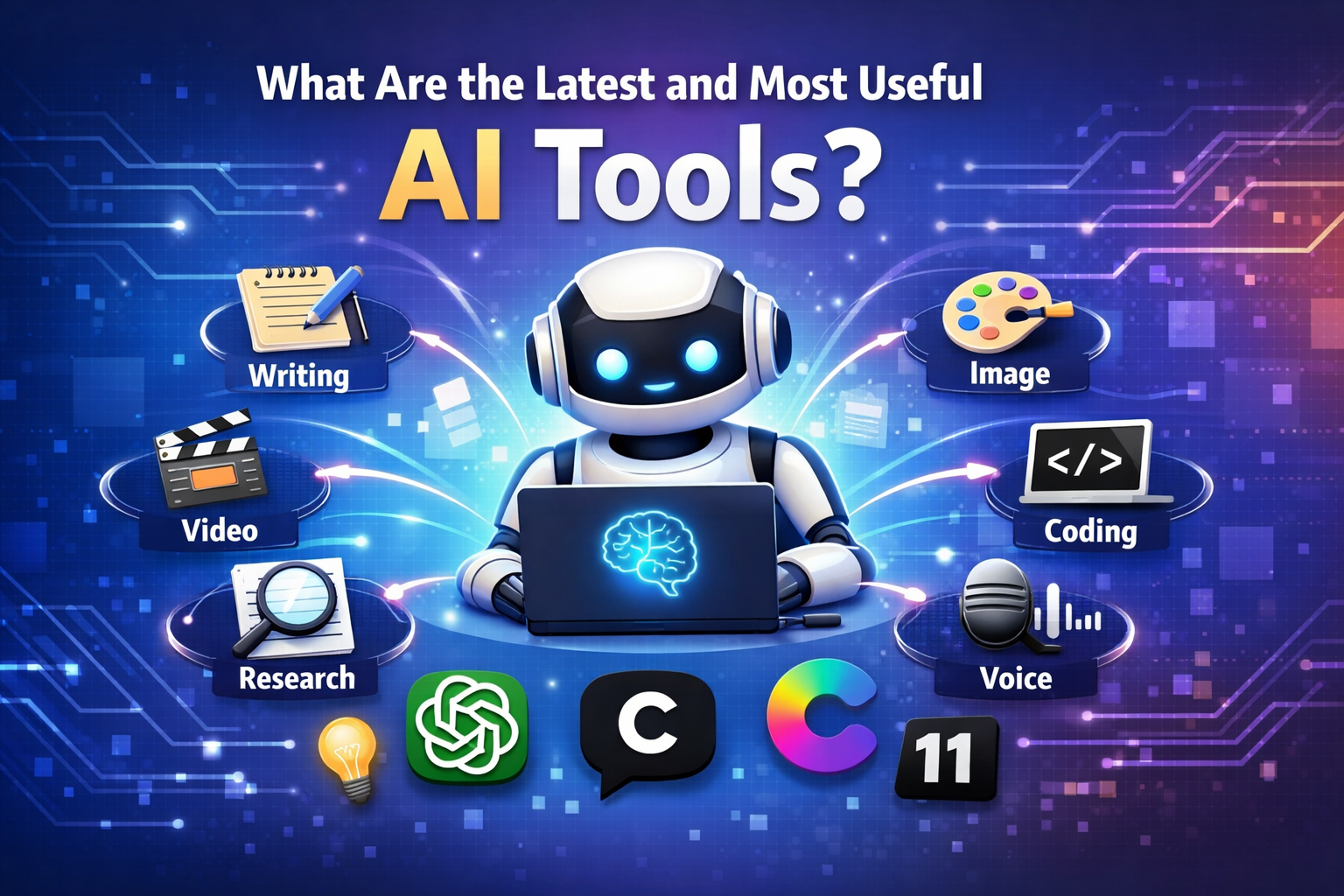
AI tools are everywhere now, but only a small group actually saves time, improves output, or helps you make money. As of April 2026, the most useful AI tools are the ones that combine strong core models with practical workflows: ChatGPT for all-around work, Claude for deep writing and analysis, Gemini for Google ecosystem tasks, Perplexity for research, Cursor for coding, Runway for AI video, Midjourney for images, Descript for editing, Notion AI for workspace productivity, Canva AI for fast design, and ElevenLabs for voice.
Quick answer
If you only want the short version:
Best overall AI tool: ChatGPT
Best for long-form writing and analysis: Claude
Best for Google-based work: Gemini
Best for research with sources: Perplexity
Best for coding: Cursor
Best for AI video generation: Runway
Best for AI image generation: Midjourney
Best for podcast and video editing: Descript
Best for notes, docs, and team knowledge: Notion AI
Best for quick design work: Canva AI
Best for voice generation: ElevenLabs
What makes an AI tool actually useful?
The newest tool is not always the most useful one. A tool becomes useful when it does at least one of these well: saves significant time, improves quality, reduces cost, fits into your workflow, or helps you ship work faster. That is why the best tools in 2026 are not just “smart”; they are practical. For example, ChatGPT continues to add product features, Claude keeps improving high-end reasoning and writing, Gemini is expanding context-aware features inside Google’s ecosystem, and Notion is pushing custom agents and AI autofill into everyday team workflows.
Best AI tools in 2026: the shortlist
Tool Best for Why it stands out
ChatGPT General use Strong all-around assistant for writing, coding, ideation, and multimodal tasks
Claude Writing and analysis Excellent for nuanced writing, long context, and thoughtful reasoning
Gemini Google-heavy workflows Strong fit for Docs, Drive, Search, and broader Google workflows
Perplexity Research Real-time web answers with citations
Cursor Coding Agent-style development inside an AI-first IDE
Runway AI video Strong text-to-video and image-to-video workflow
Midjourney Images High-quality visual generation with strong style control
Descript Editing Edit video and audio by editing text
Notion AI Workspace productivity Combines docs, search, automations, and AI in one place
Canva AI Fast design Prompt-based creation with editable design output
ElevenLabs Voice Natural AI speech and multilingual voice workflows
These picks are based on current product capabilities and recent vendor updates, not just brand familiarity.
- ChatGPT: best overall AI tool
ChatGPT is still the safest “one tool if you only pick one” option because it covers the most ground: writing, brainstorming, coding, image generation, document work, voice interaction, and web-connected tasks. OpenAI’s 2026 product updates also show that ChatGPT is still expanding as a platform, not just a chatbot.
Best for: general users, creators, marketers, founders, researchers, and teams that want one flexible assistant.
Use ChatGPT if: you want breadth.
Skip ChatGPT if: you need the absolute best specialist tool for one narrow job, like cinematic AI video or advanced image aesthetics. That is where dedicated tools can still beat it. This is an inference based on the broader capabilities described in OpenAI’s product releases versus the specialization described by Runway and Midjourney.
- Claude: best for serious writing and deep analysis
Claude remains one of the strongest choices for long-form writing, structured thinking, and document-heavy work. Anthropic’s recent releases also show that Claude is becoming more productized beyond chat, including new design-oriented workflows.
Best for: essays, strategy docs, summaries, synthesis, and nuanced writing.
Use Claude if: you care about tone, clarity, and thoughtful output.
Skip Claude if: your main need is web research with visible citations or heavy Google-native workflow integration. Perplexity and Gemini are often a better fit there.
- Gemini: best for Google ecosystem users
Gemini is most useful when your work already lives inside Google. Recent updates highlight stronger AI features across Docs, Sheets, Slides, Drive, and the Gemini app itself, plus new context-aware and canvas-style capabilities.
Best for: Google Workspace users, students, knowledge workers, and people who want AI integrated into search and productivity tools.
Use Gemini if: you already depend on Gmail, Drive, Docs, and Google Search.
Skip Gemini if: you want the strongest writing personality or research-first citation experience. Claude and Perplexity often feel more focused for those jobs. This is an inference from product positioning and feature descriptions.
- Perplexity: best for research
Perplexity’s value proposition is simple and still powerful: it is an AI answer engine that searches the web in real time and gives you sourced responses. That makes it one of the most useful tools when accuracy, current information, and speed matter more than creative writing.
Best for: fact-finding, quick research, source collection, and getting cited overviews fast.
Use Perplexity if: you want answers with sources.
Skip Perplexity if: you need polished long-form content, design, or editing workflows. It is more research assistant than full creative suite.
- Cursor: best AI tool for coding
Cursor has become one of the clearest examples of a useful AI-native product rather than a generic model wrapper. Its product messaging is now heavily centered around agentic development, where the tool helps turn ideas into code and speeds up real software work across desktop and web workflows.
Best for: developers, indie hackers, technical founders, and product builders.
Use Cursor if: you want AI embedded directly inside your development environment.
Skip Cursor if: you do not write code. It is not a general productivity tool.
- Runway: best AI video generation tool
Runway remains one of the strongest names in AI video. Its product page now presents it as a creative toolkit that brings together video, image, audio, editing, and language models, while its research pages emphasize improved motion quality, fidelity, and control.
Best for: creators, marketers, ad teams, and anyone making visual content fast.
Use Runway if: video is part of your content workflow.
Skip Runway if: you only need static images or simple social graphics. Midjourney or Canva AI will often be more direct.
- Midjourney: best AI image tool for style and aesthetics
Midjourney is still one of the strongest tools for image generation when style, mood, and visual polish matter. Its documentation highlights personalization, moodboards, image prompts, and web-based tools for generating both images and video.
Best for: concept art, thumbnails, branding visuals, and creators who care about image quality.
Use Midjourney if: aesthetics matter more than editable design layers.
Skip Midjourney if: you need drag-and-drop layouts or collaborative brand design. Canva AI is usually more practical for that.
- Descript: best for editing podcasts and videos quickly
Descript’s core advantage is still one of the clearest in the market: edit audio and video by editing text. That makes it one of the most useful AI tools for creators who do not want to spend hours in a traditional timeline editor.
Best for: podcasters, YouTubers, interview editors, and talking-head video creators.
Use Descript if: your workflow involves voice, transcripts, and fast revisions.
Skip Descript if: you need advanced cinematic editing or heavy visual effects.
- Notion AI: best for team productivity and knowledge work
Notion is pushing hard toward becoming an AI workspace, not just a notes app. Its current product pages emphasize custom agents, enterprise search, meeting notes, workflow automation, and AI inside docs and databases. Recent release notes also highlight Custom Agents, AI Autofill, and workflow skills.
Best for: teams, operators, project managers, and knowledge-heavy businesses.
Use Notion AI if: your work already lives in Notion.
Skip Notion AI if: you want a pure chatbot experience rather than workspace-native AI.
- Canva AI: best for fast design and marketing assets
Canva AI is increasingly useful because it is moving beyond template generation into prompt-based creation with editable outputs. Canva’s recent AI 2.0 announcement stresses layered object intelligence, meaning generated designs remain editable instead of becoming flat locked images.
Best for: marketers, content creators, founders, and non-designers.
Use Canva AI if: you need presentations, social graphics, simple landing assets, and fast branded output.
Skip Canva AI if: you need highly artistic image generation or top-tier motion video generation.
- ElevenLabs: best AI voice tool
ElevenLabs remains one of the most useful voice AI tools because it combines lifelike text-to-speech, multilingual support, voice design, and agent workflows. Its current product materials emphasize 70+ languages and more expressive voice controls in its newer voice model.
Best for: voiceovers, dubbing, narration, character voices, and audio-first products.
Use ElevenLabs if: audio quality matters.
Skip ElevenLabs if: you only need rough internal narration and do not care much about realism.
Which AI tool should you choose?
The best AI tool depends less on hype and more on your main bottleneck:
Choose ChatGPT if you want the best all-purpose starting point.
Choose Claude if writing quality and analysis matter most.
Choose Gemini if you live inside Google products.
Choose Perplexity if research speed and citations matter most.
Choose Cursor if you build software.
Choose Runway if you make AI videos.
Choose Midjourney if you care about beautiful images.
Choose Descript if editing is your bottleneck.
Choose Notion AI if your team needs an AI workspace.
Choose Canva AI if you need fast marketing design.
Choose ElevenLabs if voice is core to your workflow.
Final verdict
The latest and most useful AI tools in 2026 are not necessarily the ones with the loudest launch buzz. The best ones are the tools that fit a real workflow and remove a real bottleneck. For most people, ChatGPT is still the best starting point. For specialists, the better picks are usually Claude, Perplexity, Cursor, Runway, Midjourney, Descript, Notion AI, Canva AI, or ElevenLabs, depending on the job.
FAQ
What is the best AI tool right now?
For most users, ChatGPT is still the best all-around AI tool because it covers the widest range of use cases in one product.
What is the best AI tool for research?
Perplexity is one of the best research tools because it searches the web in real time and shows sources directly in its answers.
What is the best AI tool for content creators?
That depends on the workflow: Runway for AI video, Midjourney for visuals, Descript for editing, Canva AI for fast design, and ElevenLabs for voice.
What is the best AI tool for teams?
Notion AI and Gemini are strong choices for teams because they connect AI to documents, shared knowledge, and existing workspace tools.
Are newer AI tools always better?
No. In practice, the most useful AI tools are the ones that save time consistently and fit your real workflow, not just the newest launches. That conclusion is based on the product capabilities and positioning across the tools above.