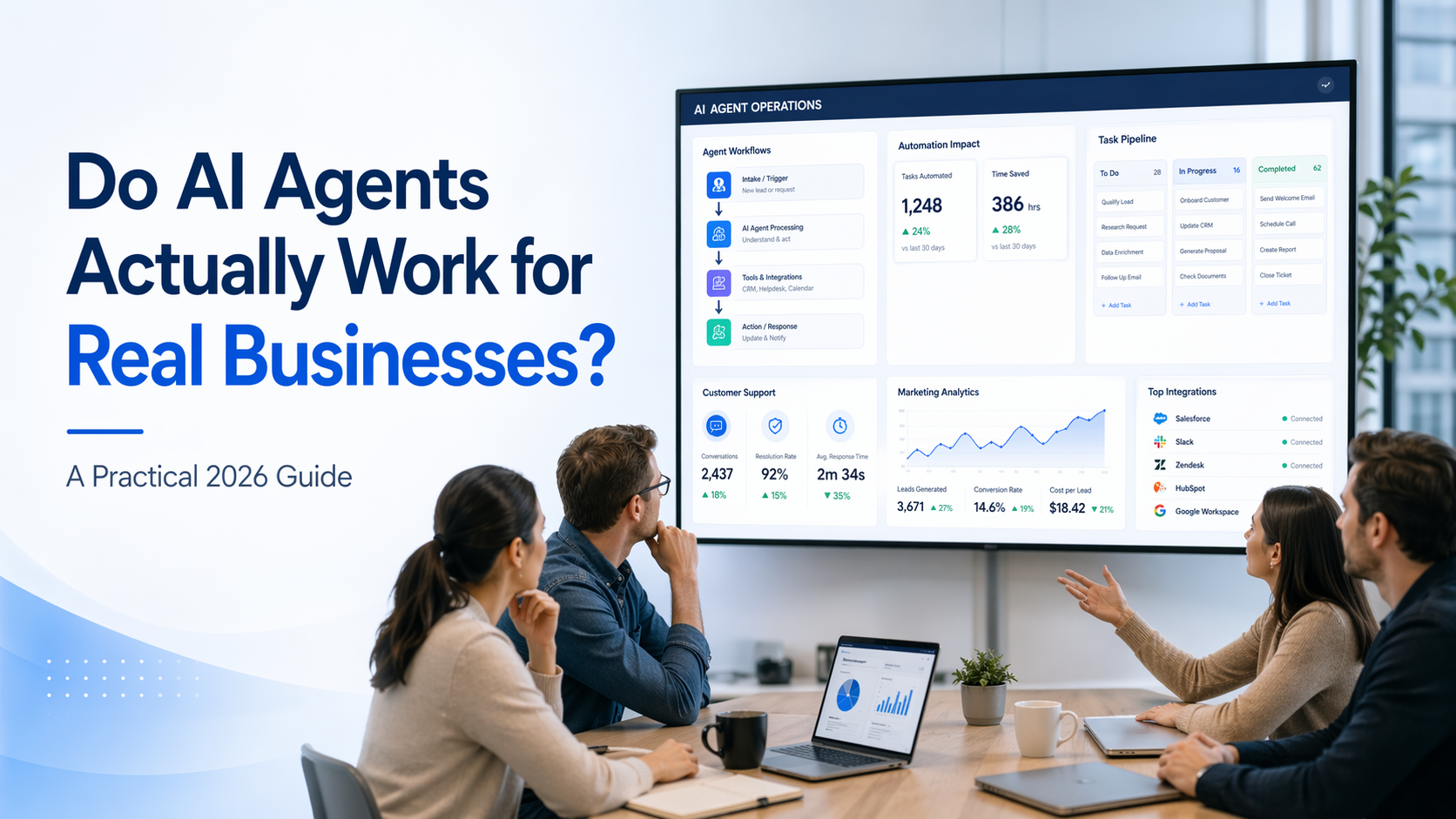
AI agents are everywhere in 2026. Every software company seems to claim that its product can “automate work,” “think for your team,” or “run business processes on autopilot.”
But for real businesses, the more important question is simple:
Do AI agents actually work?
The honest answer is: yes, AI agents can work for real businesses, but not in every situation, not without setup, and not as fully autonomous replacements for human teams.
AI agents work best when they are used for clear, repeatable, information-heavy workflows such as customer support, marketing operations, research, lead qualification, content planning, reporting, and internal workflow automation.
They work poorly when businesses expect them to replace strategy, judgment, accountability, or messy human decision-making.
In other words, AI agents are not magic employees. They are more like workflow accelerators.
Quick Answer: Do AI Agents Actually Work?
Yes, AI agents work for real businesses when three conditions are true:
The task has a clear goal.
The agent has access to the right tools, data, and workflow.
Humans still review important decisions.
AI agents are already moving from experiments to real business use. Deloitte’s 2026 enterprise AI research says companies are increasingly focused on ROI, production deployment, governance, and workforce readiness, not just AI experiments.
But the same trend also shows why businesses need to be careful. McKinsey notes that as AI systems gain more autonomy, the consequences of failure become more serious because agents can make recommendations, trigger actions, and interact with other systems.
So the real question is not “Do AI agents work?”
The better question is:
Where do AI agents work well enough to create business value?
What Is an AI Agent in Business?
An AI agent is a software system that can take a goal, understand context, use tools, make decisions within limits, and complete a task with some level of autonomy.
A basic chatbot answers questions.
An AI agent can do more. It may:
Read customer messages
Search a knowledge base
Draft a reply
Update a CRM
Create a task
Summarize a conversation
Trigger a workflow
Hand off complex cases to a human
That difference matters.
For a real business, an AI agent is useful only when it connects to actual work. A tool that simply “chats” is not enough. A useful business agent should help move a process forward.
Where AI Agents Actually Work for Real Businesses
AI agents work best in areas where businesses already have repeatable workflows, clear information sources, and measurable outcomes.
Here are the strongest business use cases.
- Customer Support AI Agents
Customer support is one of the clearest areas where AI agents can work.
A support AI agent can help answer common questions, classify tickets, summarize customer issues, suggest replies, and route difficult cases to the right person.
This works especially well for businesses that already have:
A help center
FAQ pages
Product documentation
Standard refund or cancellation rules
Repeated customer questions
For example, an e-commerce business may use an AI agent to answer questions about order status, shipping delays, return policies, product sizing, and basic troubleshooting.
The agent does not need to “invent” answers. It needs to retrieve the right information and apply the company’s rules.
Best fit:
Customer support teams, e-commerce stores, SaaS companies, service businesses, and online marketplaces.
Weak fit:
Sensitive complaints, legal issues, angry customers, account disputes, and high-value enterprise clients that require human judgment.
Internal link suggestion:
Read next: Best AI Agents for Customer Support Automation
- Marketing AI Agents
Marketing is another strong area for AI agents because a lot of marketing work involves research, planning, drafting, repurposing, and reporting.
A marketing AI agent can help:
Research competitors
Generate content briefs
Draft social posts
Repurpose blog content
Analyze campaign performance
Suggest email sequences
Build landing page outlines
Prepare SEO topic clusters
For small teams, this can be valuable because marketing often has more tasks than people.
But there is a limit.
AI agents can help with execution and workflow speed. They should not fully replace positioning, brand judgment, customer insight, or final editorial control.
Best fit:
Small marketing teams, content teams, affiliate marketers, agencies, solo founders, and B2B growth teams.
Weak fit:
Brand strategy, controversial messaging, deep customer research, and final creative direction.
Internal link suggestion:
Read next: Best AI Agents for Marketing Automation
- Workflow Automation AI Agents
Workflow automation is where AI agents start to become more powerful.
Traditional automation tools usually follow fixed rules:
“If this happens, do that.”
AI agents can add judgment and flexibility:
“Read this request, decide what type it is, collect the needed information, and send it to the right workflow.”
This is useful for tasks such as:
Intake forms
Internal requests
Meeting summaries
CRM updates
Lead routing
Document review
Task creation
Approval preparation
Report generation
Gartner has predicted that enterprises will increasingly move away from simple assistive AI and toward outcome-focused workflow platforms by 2028.
That is exactly where AI agents may become valuable: not as chatbots, but as parts of business workflows.
Best fit:
Operations teams, agencies, sales teams, admin-heavy businesses, and small companies with repeated manual processes.
Weak fit:
Highly regulated processes, unclear approval chains, or workflows where bad actions are costly.
Internal link suggestion:
Read next: Best AI Agents for Workflow Automation
- Research and Knowledge Work Agents
AI agents can also help with research-heavy work.
They can collect information, summarize documents, compare options, prepare first drafts, and organize findings.
For example, a business may use an AI research agent to:
Compare software vendors
Summarize market trends
Analyze customer reviews
Create research briefs
Monitor competitors
Prepare internal reports
Extract insights from long documents
This does not mean the agent replaces expert judgment. It means the agent reduces the time spent gathering and organizing information.
Best fit:
Consultants, analysts, founders, researchers, content strategists, and business development teams.
Weak fit:
Final decisions, legal conclusions, financial recommendations, medical claims, or any area where factual errors are expensive.
- Sales and Lead Qualification Agents
AI agents can help sales teams by handling early-stage qualification and administrative work.
They may:
Enrich lead data
Score leads
Draft outreach emails
Summarize sales calls
Update CRM records
Suggest follow-up actions
Answer simple buyer questions
However, sales is also an area where expectations can become unrealistic.
Gartner predicted that by 2028 AI agents may outnumber human sellers by a large margin, but also warned that fewer than 40% of sellers may report productivity improvements from those agents.
That is an important warning.
More agents does not automatically mean better sales. Businesses still need good offers, good data, good processes, and human relationship-building.
Best fit:
Lead qualification, CRM cleanup, follow-up reminders, sales research, and pipeline summaries.
Weak fit:
Complex negotiations, enterprise deals, trust-building, pricing strategy, and final closing.
Where AI Agents Usually Fail
AI agents fail when businesses expect too much too soon.
The most common failure points are not mysterious. They are practical.
- The Business Has No Clear Workflow
AI agents need structure.
If your business process is unclear, inconsistent, or handled differently by every employee, an AI agent will struggle.
Before adding an agent, ask:
What is the exact task?
What does success look like?
What information does the agent need?
What should the agent never do?
When should it hand off to a human?
If you cannot answer these questions, the problem is not the AI agent. The problem is the workflow.
- The Data Is Messy
AI agents are only as useful as the information they can access.
If your documentation is outdated, your CRM is messy, your product information is scattered, or your internal rules are unclear, the agent may produce unreliable results.
This is especially important for customer support, sales, and internal operations.
Bad data creates bad automation.
- The Agent Has Too Much Autonomy
Businesses often get excited about “fully autonomous” AI agents.
But in real business environments, full autonomy can be risky.
Gartner has warned that enterprise GenAI applications may face more security incidents as adoption grows, especially as these systems become more deeply connected to business tools.
For most businesses, the safest model is not full autonomy.
It is controlled autonomy.
That means the agent can draft, classify, summarize, recommend, and prepare actions — but humans approve sensitive or high-impact decisions.
- The Company Measures the Wrong Thing
Many businesses measure AI success by activity:
Number of tasks generated
Number of messages answered
Number of workflows created
Number of prompts used
But real businesses should measure outcomes:
Did support response time decrease?
Did the team save hours?
Did leads get qualified faster?
Did content production improve?
Did customer satisfaction stay stable?
Did errors decrease?
Did revenue or conversion improve?
An AI agent that creates more noise is not working.
An AI agent that reduces friction and improves outcomes is working.
AI Agents vs Automation Tools: What Is the Difference?
Many businesses confuse AI agents with automation tools.
They overlap, but they are not the same.
Feature Automation Tool AI Agent
Main logic Fixed rules Goal-based reasoning
Best for Repeated predictable tasks Flexible information-heavy tasks
Example Send email when form is submitted Read the form, classify the request, draft a response, and create a task
Human control High Depends on setup
Risk level Lower Higher if connected to important systems
Best use Simple workflows Complex workflows with context
A traditional automation tool is best when the process is simple and predictable.
An AI agent is better when the task requires reading, interpreting, deciding, summarizing, or adapting.
In many real businesses, the best setup is not “AI agent vs automation tool.”
It is both.
Use automation tools for stable workflow steps.
Use AI agents for the parts that require language, judgment, and context.
The Best AI Agent Use Cases by Business Type
Different businesses should use AI agents differently.
Small Businesses
Small businesses usually benefit from AI agents that save time.
Good use cases include:
Customer support replies
Social media drafts
Email follow-ups
Appointment reminders
Simple lead qualification
FAQ automation
Internal task summaries
Small businesses should avoid complex autonomous agents at the beginning.
Start with one workflow that clearly wastes time every week.
Marketing Teams
Marketing teams can use AI agents for:
SEO briefs
Topic research
Competitor analysis
Content repurposing
Campaign summaries
Email sequence drafts
Landing page outlines
Performance reporting
The key is to keep humans in charge of strategy and final approval.
AI agents should speed up marketing operations, not replace marketing judgment.
Customer Support Teams
Support teams can use AI agents for:
Ticket classification
Suggested replies
Help center answers
Order status responses
Refund policy guidance
Conversation summaries
Escalation routing
The best support agents are connected to trusted knowledge sources and have clear escalation rules.
Sales Teams
Sales teams can use AI agents for:
Lead research
CRM updates
Follow-up reminders
Meeting summaries
Outreach drafts
Account research
Pipeline notes
Sales agents work best as assistants, not closers.
They help salespeople spend less time on admin and more time on real selling.
Operations Teams
Operations teams can use AI agents for:
Internal request routing
Document summaries
Approval preparation
Task creation
Status updates
Reporting workflows
Vendor comparison
Process documentation
This is one of the most practical areas for AI agents because operations teams often deal with repetitive information-heavy work.
How to Know If an AI Agent Is Worth Trying
Before choosing an AI agent, ask these questions:
Does this task happen repeatedly?
Does it involve reading, writing, summarizing, or classifying information?
Does the business already have reliable data or documentation?
Can success be measured clearly?
Can humans review important outputs?
Would saving time on this task create real business value?
If the answer is yes, an AI agent may be worth testing.
If the task is rare, unclear, risky, or highly judgment-based, AI agents may not be the right solution yet.
A Simple AI Agent Adoption Framework
For most businesses, the safest way to adopt AI agents is not to automate everything at once.
Use this framework:
Step 1: Pick One Painful Workflow
Do not start with “We need AI.”
Start with a real business problem.
For example:
Support tickets take too long
Leads are not followed up quickly
Content production is slow
Reports take hours every week
Internal requests are disorganized
Customer questions are repeated
A good AI agent project starts with a painful workflow, not a trendy tool.
Step 2: Define the Agent’s Job
Write one sentence:
“This AI agent helps us do [specific task] so that [specific outcome] improves.”
Example:
“This AI agent helps our support team draft replies to common customer questions so that response time decreases without reducing answer quality.”
If you cannot define the job clearly, the agent is not ready.
Step 3: Limit the Agent’s Permissions
Do not give the agent full access to everything.
Start with limited permissions.
For example, the agent can:
Read knowledge base articles
Draft replies
Summarize tickets
Suggest tags
Create draft tasks
But it should not:
Issue refunds without approval
Change customer accounts
Send sensitive messages automatically
Modify important records without review
Controlled access reduces risk.
Step 4: Keep Humans in the Loop
For most businesses, human review is still necessary.
The agent can prepare the work.
The human approves the work.
This is especially important for customer communication, sales decisions, financial information, legal matters, and sensitive business operations.
Step 5: Measure Business Outcomes
After testing the agent, measure the result.
Useful metrics include:
Time saved per week
Response time
Ticket resolution speed
Number of manual steps reduced
Error rate
Customer satisfaction
Conversion rate
Cost per task
Employee workload
If the agent does not improve a real metric, it is not working.
Should Every Business Use AI Agents?
No.
Not every business needs AI agents right now.
A business may not be ready if:
It has no clear workflows
Its data is messy
Its team does not know what to automate
Its processes change constantly
It works in a highly regulated area
It cannot review AI outputs properly
It expects AI to replace human judgment
In these cases, a simple automation tool, better documentation, or a cleaner process may create more value than an AI agent.
AI agents are powerful, but they are not the first step for every business.
When AI Agents Are Worth It
AI agents are worth trying when:
Your team repeats the same information-heavy tasks
You have clear rules or documentation
You can measure the result
Human review is possible
The agent saves meaningful time
The task is important but not too risky
The best early use cases are usually not dramatic.
They are practical.
A good AI agent may not “run your company.”
But it may save your team 5–10 hours per week, reduce response time, clean up workflows, or help a small team operate like a larger one.
That is real business value.
Final Verdict: Do AI Agents Actually Work?
AI agents do work for real businesses, but only when they are used with realistic expectations.
They are not fully autonomous employees.
They are not a replacement for strategy.
They are not a shortcut around bad processes.
They are not guaranteed to improve productivity just because they sound advanced.
But when used correctly, AI agents can help real businesses save time, reduce manual work, improve response speed, organize information, and automate parts of daily operations.
The best businesses will not ask:
“Can AI agents replace our team?”
They will ask:
“Which workflows can AI agents make faster, cleaner, and easier to manage?”
That is where AI agents actually work.
Recommended Next Steps
If you are exploring AI agents for your business, start with the workflow you want to improve first.
Then choose the right type of agent:
For marketing workflows, read: Best AI Agents for Marketing Automation
For support teams, read: Best AI Agents for Customer Support Automation
For internal operations, read: Best AI Agents for Workflow Automation
For broader business use cases, read: Best AI Agents for Business Workflows
AI agents are not the answer to every business problem.
But for the right workflow, they can be one of the most useful business tools in 2026.
FAQ
Do AI agents really work?
Yes, AI agents can work when they are used for clear, repeatable, information-heavy tasks. They are most useful in customer support, marketing, workflow automation, research, sales admin, and internal operations.
Can AI agents replace employees?
In most real businesses, AI agents are better at assisting employees than replacing them. They can reduce manual work, draft responses, summarize information, and automate workflow steps, but humans are still needed for judgment, strategy, and accountability.
What are AI agents best used for?
AI agents are best used for tasks that involve reading, writing, classifying, summarizing, routing, researching, and preparing actions. They work well when connected to reliable business data and clear workflows.
Why do AI agents fail?
AI agents often fail because the business has unclear processes, messy data, unrealistic expectations, too much autonomy, or no clear success metric.
Are AI agents better than automation tools?
AI agents are not always better. Automation tools are better for simple, predictable workflows. AI agents are better for flexible tasks that require language understanding, context, or decision-making.
Should small businesses use AI agents?
Small businesses can benefit from AI agents if they start with simple use cases such as customer support replies, lead follow-ups, content planning, and task summaries. They should avoid complex autonomous systems at the beginning.
What is the safest way to use AI agents?
The safest way is to start with one workflow, limit the agent’s permissions, use trusted data, keep humans in the loop, and measure business outcomes.
I found a relevant video that gives a practical overview of how AI agents work in real business settings. You can watch it below for additional context.👇